
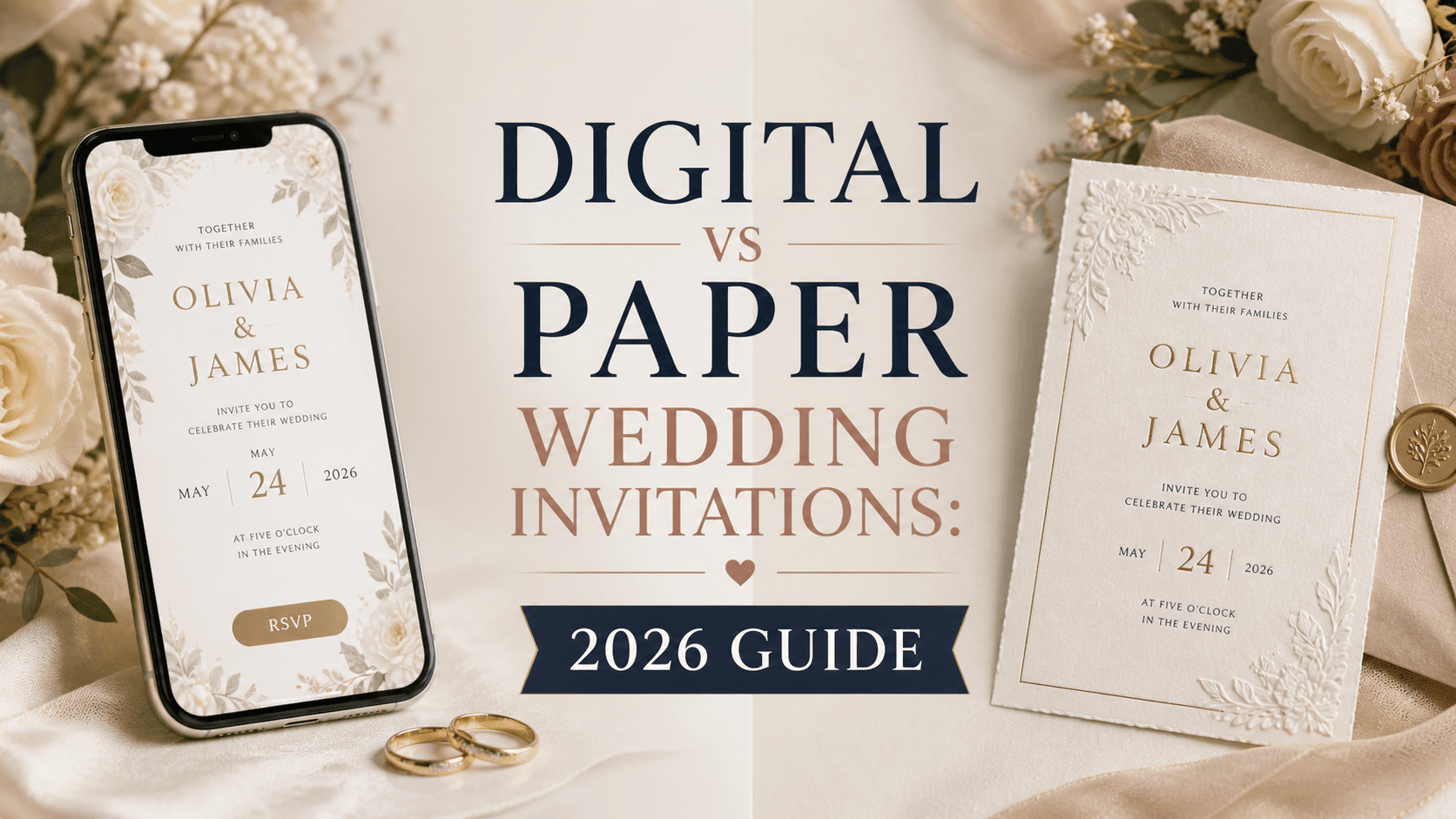
The wedding industry has a $400 billion problem: tradition that doesn't always serve the couple. Nowhere is this more visible than in the question of paper versus digital invitations. The expectation is paper. The reality, increasingly, is digital. The right answer for your wedding depends less on tradition and more on the actual experience you want for your guests.
Couples planning weddings in 2026 face a real choice. Paper invitations carry centuries of formal weight and physical beauty. Digital invitations carry features no paper can match: real time RSVPs, dietary collection, integrated wedding websites, multi day event coordination, and the ability to update guests instantly when plans change.
This guide is the honest comparison: what each does well, what each costs, what your guests actually expect, and how the smartest couples in 2026 handle the decision.
Quick answer
For most modern weddings, digital invitations are the smarter primary choice. They save 70 to 95% of the cost, eliminate RSVP chasing, support multi day events, integrate wedding websites, and let you update details freely. Paper still wins for the formal printed keepsake (the framed grandparent invitation), the highly traditional or religious ceremony, and the destination wedding where the printed card is part of the experience. The best path for most couples is hybrid: digital for the entire guest list, paper for 5 to 15 close family members.
Quick comparison
| Factor | Digital | Paper |
|---|---|---|
| Cost (150 guests) | $0 to $25 total | $1,500 to $5,000 |
| Time from design to inbox | Hours | 4 to 12 weeks |
| RSVP tracking | Automatic, with dietary, plus ones, song requests | Manual phone calls, missed cards |
| Multi day wedding (rehearsal, ceremony, brunch) | One invitation, multiple events | Three or four separate invitations |
| Wedding website integration | Direct embed | Printed URL guests must type |
| Update after sending | Instant | Reprint and resend |
| International guests | Same delivery, same cost | $5 to $15 international postage per invite |
| Etiquette signal | Modern, accessible | Formal, traditional |
| Environmental impact | Negligible | ~3 to 5 kg paper plus envelopes plus shipping |
The cost reality (and what's hidden in the price)
A traditional wedding invitation suite is one of the most overpriced products in the wedding industry. A 150 guest wedding with a full paper suite (save the dates, formal invitations, RSVP cards, envelopes, postage) typically runs $1,500 to $5,000. Premium calligraphy, foiling, custom designs can push that past $7,500.
That's not the worst part. The hidden cost is the time. Couples spend roughly 30 to 60 hours over six months on invitation related work: choosing designs, proofreading, addressing envelopes, mailing them, tracking RSVPs by phone, chasing the missing 30%, updating dietary information manually, coordinating plus one decisions. None of this is creative work. It's logistics.
Digital wedding invitations cost $0 to $25 total. The 30 to 60 hours come back to you. You spend the saved budget on the wedding itself, the honeymoon, the savings account, or the actually beautiful one paper invitation you mail to your grandmother to put on her fridge.
Couples who switch usually report the same thing afterward: they spent the saved money on something the guests actually noticed (better food, better music, better photographs) instead of stationery that ended up in the recycling within two weeks.
The etiquette question (the one that keeps couples up at night)
Here's the truth about wedding invitation etiquette in 2026: the rules have changed, and the older relatives know it.
Older etiquette guides insisted on engraved or letterpress paper invitations as the only acceptable form. That standard came from a 1950s era when paper was the only practical way to invite a large group, when long distance phone calls were expensive, when handwritten correspondence was the universal sign of personal effort. None of those constraints exist anymore.
Modern etiquette experts (including the ones at The Knot, Martha Stewart Weddings, and Emily Post Institute) now openly accept digital wedding invitations as appropriate for most weddings. The signal of effort has shifted from medium to design quality and personalization. A beautifully designed digital invitation with the couple's photo, custom typography, animated reveal, and thoughtful guest specific greetings often signals MORE care than a generic printed card from a stationer.
The exceptions are real but narrow:
- Highly formal religious ceremonies where the printed invitation is part of the cultural protocol
- Multi generational family expectations where elders specifically frame paper as required, and the couple decides this matters more than convenience
- Black tie weddings at venues where formality is the entire point
For everything else (modern weddings, destination weddings, intimate ceremonies, second weddings, casual receptions), digital is socially fine. The couples who tell you otherwise are usually echoing rules they were told 20 years ago.
Tradition versus modernity
Tradition is not paper. Tradition is the ceremony, the vows, the rings, the dance, the food, the family gathering. The invitation is the announcement, not the substance.
That said, paper invitations carry a sentimental weight that's worth acknowledging. The first time someone you love hands you a wedding invitation envelope is a small moment that doesn't replicate digitally. The framed wedding invitation in someone's home is a real keepsake. For one specific guest at your wedding (often a parent, grandparent, or close friend), the paper version genuinely matters.
The rest of the guest list? They open the link, RSVP, screenshot it for their calendar app, and move on. Paper would have taken the same path with one extra step: open the envelope, read the card, read the RSVP card, find a stamp, mail it back, hope the postal service delivers it in time.
RSVP, dietary preferences, plus ones, and song requests
Wedding RSVPs are the source of approximately 80% of pre wedding stress. Paper RSVPs depend on:
- The guest remembering to RSVP at all (40 to 60% don't, in practice)
- The guest mailing the card by the deadline
- The card actually arriving
- The guest writing legibly
- The couple receiving and processing each card
Digital RSVPs solve this in seconds. The guest taps the link, selects yes or no, optionally adds dietary requirements, names the plus one, and submits. The couple sees the count update in real time on the dashboard. No phone calls. No spreadsheet. No "Did you receive Aunt Margaret's card?"
For weddings with sit down dinners, this is not a small benefit. Caterers need accurate dietary counts. Vegan, gluten free, kosher, halal, allergies, child meal counts. Paper invitations leave this on a tiny line that half of guests skip. Digital invitations can require it, store it, and export to the caterer in one click.
The same applies to song requests, plus one names, transportation needs, and accommodation help. Digital invitations turn the RSVP into the planning tool itself.
Multi day weddings: the four invitation problem
A modern wedding is rarely one event. There's the welcome dinner, the rehearsal, the ceremony, the reception, the morning after brunch. Some weddings span three days. Some include destination travel coordination.
With paper, each event would require its own invitation card. Save the date, then formal invitation, then rehearsal dinner card, then brunch card. Some couples send four separate paper mailings over six months. The cost compounds. The mailing labor compounds. The chance of a confused guest compounds.
Digital invitations let you put the entire weekend on one invitation. Friday welcome dinner: 7pm, dress code, location. Saturday ceremony: 4pm, transportation. Saturday reception: 6:30pm, dress code, plus ones. Sunday brunch: 10am, casual. The guest sees everything in one view, RSVPs to the events they can attend, gets directions and timing for each. The couple sees a per event headcount automatically.
Destination weddings and international guests
Destination weddings have a unique problem: international postage. Mailing a paper invitation to Tokyo costs about $9 (in the US). To Mexico City: $5. To London: $8. For a 150 guest destination wedding with international family, paper postage alone can run $500 to $1,500.
Digital invitations have one delivery channel and one cost (effectively zero) regardless of where the guest lives. The cousin in Manila gets the invitation in the same second as the cousin in Manchester. Time zone confusion is solved by built in calendar export. International dates and venue addresses don't get garbled by calligraphy.
For destination weddings specifically, the digital case is overwhelming. Paper invitations for a destination wedding are nostalgic at best, financially silly at worst.
Save the dates: where digital is already winning
Save the dates have been quietly migrating to digital since around 2018. The data point that doesn't get talked about enough: most couples in 2026 who are using paper invitations are STILL using digital save the dates.
Why? Save the dates have one job: tell the guest the date and place far enough in advance that they can plan. There's no formal etiquette weight. There's no keepsake expectation. Speed and reach matter most. Digital wins by a mile.
If you're already comfortable sending a digital save the date, you're already comfortable with the medium. The question is whether the formal invitation needs paper. For most weddings: it doesn't.
The wedding website angle
This is the unique advantage digital has, and it gets underappreciated.
A wedding website is the place where the full information lives: schedule, venues, accommodation, dress code, gift registry, photos, FAQ, contact info for the planner, transportation, parking, and any updates. Paper invitations CAN include a printed URL but most guests don't bother typing it (they'll text the couple instead, which becomes its own labor).
A digital invitation IS the wedding website (or links directly to it). The guest opens the invitation, sees the website, has every answer they need before RSVPing. The couple gets fewer questions, fewer text messages, fewer "what time again?" repeat asks. The information stays in one place that the couple controls.
Some platforms (including Invyt) ship wedding website templates that are part of the invitation product. Others require building a separate site and linking. Either way, digital invitations are the natural front door.
Personalization that paper cannot match
Paper invitations let you choose paper stock, foil, embossing, ribbon, calligraphy. Real, tactile customization. Beautiful for what it is.
Digital invitations let you choose:
- Animated reveals when the guest opens the link
- Personalized greetings (the invitation can address each guest by name)
- Embedded photos and videos from the engagement journey
- Real time countdown to the wedding
- Music selection that plays when the invitation opens
- Dress code visual examples
- Venue photos and location maps
- Built in directions integration
- Pre wedding announcements as the date approaches
None of this is possible on paper. Paper invitations peak at "the cover stock feels nice." Digital invitations can include the moment the couple got engaged playing as a video for each guest. Both are valid. They're solving different problems.
Environmental cost at wedding scale
A single wedding's paper invitations is roughly 3 to 5 kilograms of paper, plus ink, plus envelope mailers, plus postage shipping. For 150 guests with the full suite (save the date, formal, RSVP, brunch card), the carbon and waste cost is meaningful.
Across the wedding industry, this adds up. The roughly 2 million weddings per year in the US alone produce an estimated 6 to 10 million kilograms of paper waste from invitations. Most ends up recycled within a month.
For environmentally conscious couples, the cost calculation matters. Digital invitations have a small footprint (server energy and screen time) but it's negligible compared to printing and shipping. For couples who care, this is a real factor.
When paper still wins
Paper is the right choice for:
- Highly formal weddings where the engraved or letterpress invitation IS the formal communication
- Religious ceremonies where the printed invitation has cultural or sacramental weight
- Couples who specifically want a framed keepsake invitation in their home or their parents' home
- Family situations where elders insist on paper and the couple decides to honor that
- Black tie weddings where formality is part of the experience
- Couples who genuinely love beautiful stationery as an art form (and want to spend the budget there)
None of these are wrong reasons. Paper has a place. The question is whether your wedding fits these categories.
When digital wins
Digital is the right choice for:
- Modern, casual, or contemporary weddings
- Destination weddings where international postage is impractical
- Multi day weddings with multiple events
- Weddings under 6 weeks away (paper is impossible at that timeline)
- Couples who want a real time RSVP dashboard with dietary collection
- Couples integrating a wedding website as the central source of information
- Second weddings, vow renewals, intimate ceremonies
- Couples who care about environmental impact
- Couples whose budget priority is the wedding itself, not the stationery
The hybrid approach (what most modern couples do)
The smartest couples do both:
- Send digital invitations to every guest. This is your RSVP system, your dietary collection, your wedding website front door, your update channel.
- Print 5 to 15 paper keepsakes for the people who genuinely want them: parents, grandparents, the couple themselves, perhaps wedding party members. Hand deliver or mail with a personal note.
- Skip paper for the rest of the guest list (the friends, the colleagues, the cousins, the plus ones).
This setup costs $50 to $200 instead of $1,500 to $5,000. The traditionalists are honored with their framed keepsake. The rest of the guest list gets a beautiful, fast, RSVP friendly experience. The couple keeps the saved budget for the wedding itself.
Frequently asked questions
Are digital wedding invitations considered tacky?
Not in 2026. Modern etiquette experts (The Knot, Martha Stewart, Emily Post) accept digital invitations as appropriate for most weddings. The signal of effort comes from design quality and personalization, not from the medium. A beautiful digital invitation reads as more thoughtful than a generic printed card.
Will my older relatives understand a digital wedding invitation?
The honest answer: usually yes, sometimes with help. Most relatives over 60 can RSVP from a digital invitation when shown how once. For those who genuinely cannot, mail them a printed keepsake separately. The hybrid approach (digital for everyone, paper for 5 to 15 specific elders) solves this without abandoning convenience.
How far in advance should I send wedding invitations?
Save the dates: 6 to 8 months before the wedding (12 months for destination weddings). Formal invitations: 8 to 12 weeks before the wedding (16 weeks for destination weddings). Digital invitations work at any timeline. Paper invitations need an extra 4 to 6 weeks for design, proofing, printing, and mailing.
Can a digital wedding invitation handle a black tie or formal dress code?
Yes. Premium digital invitation templates include formal serif typography, classical layouts, and minimalist palettes that read as formal. The dress code is communicated in the invitation copy and reinforced visually. Some couples worry digital signals casualness, but design carries the formality, not the medium.
What if my plans change after sending invitations?
With digital, you update once and every guest sees the new details on their next visit. With paper, you reprint, mail again, hope the new card arrives before the old one creates confusion. Couples who experienced 2020 wedding rescheduling overwhelmingly say digital invitations made the process bearable.
Can I collect wedding gift registry information through a digital invitation?
Yes. Digital invitations can link to gift registries, embed wedding website pages, and even include cash gifting integrations. Paper invitations can include a printed URL but cannot embed.
Will a digital wedding invitation work for a 200 plus guest wedding?
Absolutely. Digital scales infinitely without additional cost. Paper costs scale roughly linearly: $10 per guest at 50 guests, $10 per guest at 250 guests. Digital is functionally free at any guest count, which is when the cost case becomes overwhelming.
Bottom line
For most weddings in 2026, digital invitations are the smarter primary choice. You save 70 to 95% of the cost, you get a real time RSVP dashboard with dietary and plus one tracking, you support multi day events naturally, you integrate the wedding website, you handle international guests effortlessly, you can update plans freely, and you reduce the environmental footprint significantly.
Paper still has a place: the framed keepsake for parents and grandparents, the highly formal religious ceremony, the couple who genuinely loves stationery as an art form. The hybrid approach (digital for everyone, paper for 5 to 15 close family) honors both the convenience modern couples need and the sentiment some guests treasure.
Tradition isn't paper. Tradition is the wedding itself. The invitation is just the door.
Ready to send your wedding invitations? Browse free Invyt wedding templates: monogram, postcard, botanical, modern minimalist. Built in RSVP, dietary collection, wedding website integration, real time updates, multi day event support. No paper to mail. No RSVPs to chase.