
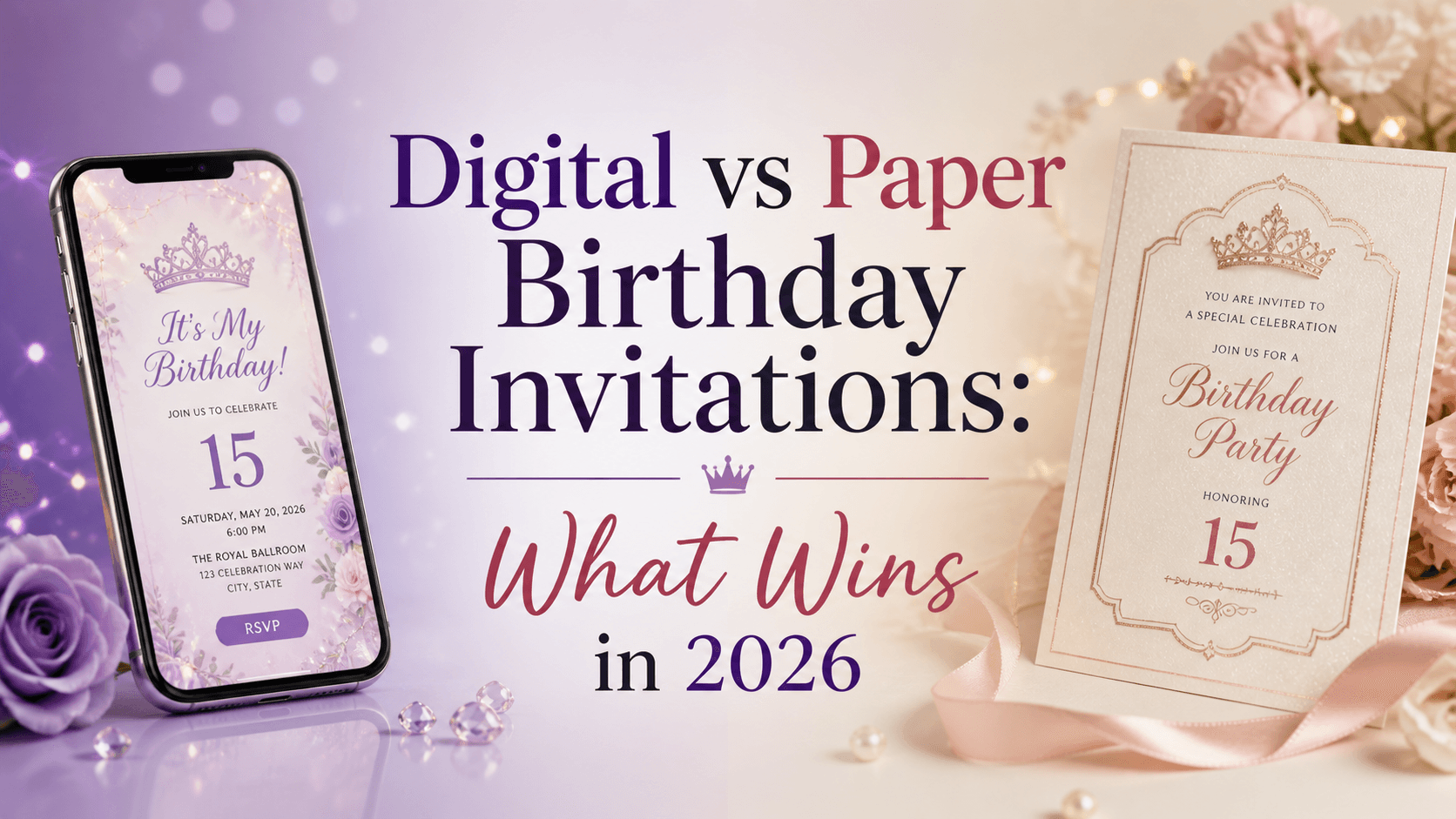
Birthdays are unlike any other event. Some are 5 year olds and bouncy houses. Some are 40th birthdays at a wine bar. Some are intimate family dinners. The "right" invitation looks completely different across all of them.
So when you ask whether digital or paper birthday invitations are better, the honest answer depends on whose birthday it is and what kind of party you're throwing.
Here's the full breakdown, with one truth most "free invitation" blogs avoid: for adult birthday parties, digital wins almost every time. For young kids' parties, paper still has a real role. For everything in between, the hybrid approach is your best move.
Quick answer
Digital birthday invitations save 80 to 95% of the cost, track RSVPs in real time, and let you change party details after sending. Paper still wins for very young kids who can't tap a phone, formal milestone events (40th, 50th, 60th), and when the invitation is meant to be a keepsake. For most birthday parties in 2026, digital is the smarter choice with paper as an optional follow up for the closest few.
Quick comparison
| Factor | Digital | Paper |
|---|---|---|
| Cost (50 guests) | $0 to $25 total | $60 to $400 |
| Time from design to inbox | Minutes | 1 to 4 weeks |
| RSVP tracking | Automatic | Manual chase |
| Last minute parties | Send today, party Saturday | Impossible |
| Edit after sending | Instant | Reprint and resend |
| Works for kids' parties | If parents handle the link | Built for school backpacks |
| Keepsake feel | Optional download or print | Included |
| Environmental impact | Negligible | ~1 kg paper for 50 invites |
The cost reality
For a 50 person birthday party, paper invitations run $60 to $400 (including envelopes, printing, and postage). For a kids' party with 30 friends, even the cheapest store bought invitations come to about $30 plus stamps. Add postage if you're mailing them rather than handing them out at school pickup.
Digital birthday invitations are typically free to $25. Even the most premium digital invitation with custom design, music, animation, and RSVP tracking is cheaper than printing 20 paper ones at the local print shop.
The savings matter most for the parties that really should not cost extra. A casual backyard birthday for a 6 year old does not need $80 of stationery. A 40th at a wine bar might justify a beautiful printed card. Digital lets you spend the budget where it actually shows up.
The kids' birthday party angle
Here is where digital birthday invitations get tricky. Young kids do not have phones. The invitation has to reach the parents.
The traditional path is paper invites tucked into school backpacks. It works. But it also depends on the kid actually delivering the envelope to the right parent, and the parent actually finding the card in the bag before the party date. Real life: about half make it.
Digital fixes this if you can collect parent phone numbers or emails. School parent groups, class WhatsApp chats, or simply asking the teacher for the class list at the start of the year all give you the channel. Once you have it, sending a digital birthday invitation by text means it goes straight to the parent's phone, not into a crumpled backpack.
For very young kids (under 5) where the party feels traditional and the parents are mostly close family, paper still works fine. For school age kids (5 to 12) where the guest list is friends from school, a hybrid works best: digital for parents you have contact details for, paper handed out at the school gate for everyone else.
The adult birthday party
For adult birthdays, digital is almost always the right answer.
Adults check their phones constantly. They reply on the spot. They share the link to a partner who needs to check the calendar. They forward it to a friend who was not on your original list but should have been. None of that happens with paper.
For milestone birthdays (30th, 40th, 50th, 60th, 70th), the calculation gets more nuanced. These tend to be larger gatherings, often with mixed ages, and the invitation itself signals the level of effort. A beautiful digital invitation with countdown timer, photo gallery, and RSVP tracking can feel just as premium as paper, often more so. Paper makes sense if you want it to be a literal keepsake on the fridge.
Surprise parties? Digital wins by a mile. The element of surprise depends on rapid coordination, easy updates if plans change, and the ability to discreetly invite guests without anyone seeing a paper invitation in the family member's mailbox.
RSVP and the headcount problem
The single biggest pain point for birthday hosts is the headcount question. How many cupcakes? How many party bags? How many seats? Paper RSVPs are notoriously unreliable for casual events. Roughly half of guests forget to RSVP at all, and you end up texting people the day before.
Digital invitations track RSVPs the moment the guest opens the invitation and taps "yes." You see the count in real time. You can collect dietary requirements, plus ones, allergies (critical for kids' parties with peanut, dairy, gluten concerns), and song requests in the same flow.
This isn't a small benefit for a kids' party. It is the difference between knowing exactly how many gluten free cupcakes to bake versus making 30 of everything just in case.
Speed: the last minute party scenario
You decided yesterday to throw a birthday party next Saturday. Paper invitations are now impossible: print shop turnaround is 3 to 5 days, plus mailing time. You will be hand delivering invitations the same day people are showing up.
Digital invitations solve this. Send today, guests RSVP within hours, you have your headcount tomorrow. The whole "do you have time to send invitations?" question goes away.
This matters more than people realize. Last minute birthday parties used to be impossible. Now they are casual.
Personalization that fits the moment
Paper birthday invitations let you choose stock, foil, ribbon, calligraphy. Beautiful. Tactile. The kid puts it in a memory box.
Digital birthday invitations open different personalization: the cake confetti animation when the guest opens the link, the countdown ticking down to the actual moment, photo galleries of past parties, integrated playlists, embedded location maps, dress code visuals. None of that is possible on paper.
For kids' parties, digital can show the bouncy house in a video, the cake design in advance, the goodie bag preview. For adult parties, digital can include a real time countdown to the night, a photo of the venue, even live updates as the party gets closer.
The environmental angle
Fifty paper birthday invitations is roughly 1 kilogram of paper, plus ink, plus envelopes, plus postage shipping. Most of them go in the recycling within a week.
Digital invitations have a small footprint (the energy to send a few hundred KB of data) but it is functionally negligible compared to a paper run. For families who care about waste, this is a real factor. For older kids who are increasingly aware of climate impact, it can also be a teaching moment.
When paper still wins
Paper birthday invitations are the right choice when:
- The birthday is for a child under 5 and the guests are mostly close family
- The invitation is itself part of the gift or the keepsake (the printed invitation goes in the kid's birthday memory box)
- It's a milestone birthday (50th, 60th, 70th) and the formal printed invitation signals importance
- You don't have a way to reach the parents of every classmate digitally and the school encourages backpack delivery
- The invitation design is so beautiful (foiled, embossed, hand calligraphed) that handing it over is part of the moment
When digital wins
Digital birthday invitations are the right choice when:
- The birthday is for an adult or a teenager who lives on their phone
- The party is less than 4 weeks away
- You want to track RSVPs without manual phone calls
- You need to collect dietary needs, allergies, plus ones, or song requests
- The party details might change and you want to update everyone instantly
- You want to add a photo gallery, countdown, dress code reference, or location map
- You're throwing a surprise party and need stealth coordination
- You want to spend the budget on the actual party, not the invitations
The hybrid approach (often best)
For mid range birthdays (school age kids, casual adult parties), the smartest move is both:
- Send digital to everyone whose phone or email you have
- Print 5 to 10 paper invitations for the kids whose parents you don't have contact details for, hand delivered at school
- Skip paper for everyone else
For a milestone or formal birthday, flip it:
- Print beautiful paper invitations for VIPs (parents, grandparents, closest friends, anyone who would frame it)
- Send digital to everyone else for RSVP convenience
Frequently asked questions
Are digital birthday invitations cheap looking?
Not anymore. Modern digital invitation platforms ship templates that look as polished as printed cards, with features paper cannot match: animated reveals, countdowns, embedded photos, real time RSVP tracking. Cheap looking digital invitations exist, but so do cheap looking paper ones.
Can I send birthday party invitations to kids' classmates digitally?
Yes, if you have parent contact details. School parent WhatsApp groups, class email lists, or simply asking the teacher for the class roster at the start of the year all work. If you don't have those details, hand deliver paper invitations at school pickup is still the easiest fallback.
How far in advance should I send birthday invitations?
For a casual party: 2 to 3 weeks. For a milestone birthday or anything requiring travel: 4 to 6 weeks. For a surprise party: 2 to 4 weeks discreetly. Digital invitations are flexible at any timeline. Paper invitations need 1 to 2 extra weeks for printing and mailing.
What if I send digital and Grandma can't open it?
Walk her through it once on the phone. Most older relatives can RSVP from a digital invitation if shown how. If she truly cannot, mail her a printed version separately. The grandmother gets her keepsake and you save the cost of a full paper run for everyone else.
Can I collect kids' allergies and dietary needs through a digital invitation?
Yes, and it's one of the best reasons to switch. Add an allergy or dietary question to the RSVP form. Parents fill it in once, you have a clean list before the party. No more chasing 30 individual texts the week before.
Is it tacky to send a digital invitation for a 50th birthday?
Not at all. The right design matters more than the medium. A beautifully designed digital invitation with a real photo gallery and countdown often feels more personal than a generic printed card. If the party is formal black tie, paper might still feel right. If it's a relaxed gathering, digital is fine.
Bottom line
For most birthday parties in 2026, digital is the smarter choice. You save money, track RSVPs in real time, send last minute, update details freely, and avoid the paper waste. Paper still wins for very young kids' parties, formal milestone events, and when the invitation is meant as a keepsake.
The honest truth: the invitation is just the prelude. What guests remember is the party itself. Spend the energy there.
Ready to send your birthday invitations? Browse free Invyt birthday templates: confetti, sunshine, modern, kids, milestone. RSVP tracking, dietary collection, and live updates all included. No paper to mail. No headcount stress.